
| Measure | Value | Planning use |
|---|---|---|
| Median annual wage, May 2025 | $135,980 per year | A mid-point for all employed software developers. Use it to sense-check an offer, not as an expected starting salary. |
| Projected employment change, 2025 to 2035 | +10.2%, against +3.5% for all occupations | Demand is projected to grow faster than the job market overall, which supports choosing this path. |
| Average annual openings, 2025 to 2035 | 95,300 openings per year | Gives a sense of the scale of hiring in a typical year across the occupation. |
| Typical entry education | Bachelor’s degree; no related work experience or on-the-job training required | Plan the route around a degree. Work experience is not a formal entry requirement. |
These figures are US Bureau of Labor Statistics data for software developers, as compiled by ConnectPrep.
What does a software engineer do? The role centres on analysing user needs and developing software solutions. It usually requires a bachelor’s degree, and the national median wage was $135,980 per year in May 2025.
This page treats the role as the baseline for comparison with other tech jobs, covering pay and demand first, then the daily work and how a career in the field develops.
Pay: what the national figures mean for planning
The national median annual wage for software developers was $135,980 in May 2025, according to BLS data reported by ConnectPrep. The mean was higher, at $148,100 per year, which indicates that the best-paid workers pull the average above the middle of the distribution.

The spread matters more than either number. The 10th percentile sat at $82,460 and the 25th at $105,210. The 75th percentile reached $171,980 and the 90th $214,670.
The software engineer salary question has a built-in limit. The wage figures cover all employed workers, so they are not starting salaries and not the earnings of graduates from any particular programme. Several practical decisions follow from that.
- Benchmark offers against the band. An offer near the 25th percentile and one near the 75th describe very different positions, even though both sit within the national range.
- Do not treat the median as a graduate target. Because it blends every experience level, a first role can reasonably sit below it.
- Check local medians before relocating. State and metro medians differ widely from the national figure, so a move can change the comparison substantially.
- Compare total packages, not only base wage. The wage series reports wages, so any comparison with an employer’s offer should line up like with like.
Demand and entry requirements
BLS projects employment of software developers to grow from 1,717,800 in 2025 to 1,892,600 in 2035, a rise of 10.2%. All occupations are projected to grow 3.5% over the same period. In May 2025 the occupation employed 1,687,890 workers, according to the BLS occupational survey as reported by ConnectPrep.
The typical entry route is a bachelor’s degree, and no related work experience or on-the-job training is required. The occupational database O*NET places the job in Job Zone Four, described as considerable preparation needed. Treat that as a signal that the route takes sustained study, not a short course.
- Degree route. Computer Science, classification code CIP 11.0701, is the programme mapped to this occupation, so it is the most direct match for employers’ expectations.
- Experience is not a formal gate. Without a related-experience requirement, projects and internships still help a candidate stand out, but the national description does not demand them.
- Self-directed learners. A candidate without a degree is working against the typical pattern, and should expect to demonstrate skills in other ways.
With pay and entry conditions clear, the next question is what the working day contains.
What a software engineer does day to day
The national occupational description frames the work around a few core duties: analysing what users need, building software to meet that need, improving software that already exists, writing specifications, and sometimes maintaining databases. The sections below take each in turn.
Analysing needs and building solutions
The first duty in the description is to analyse user needs and develop software solutions, applying principles and techniques of computer science, engineering and mathematical analysis. In practice this means that writing code is only one part of the job. Understanding the problem comes before the build, and the description lists both together.

Updating and enhancing existing software
The description also covers updating software or enhancing existing software capabilities. Much of the work therefore happens inside code that already runs, so reading and understanding an existing system is as useful a skill as writing new code. For a newcomer, that is a point in favour of learning to follow other people’s work early.

Specifications, hardware and databases
Software developers may work with computer hardware engineers to integrate hardware and software systems. They may also develop specifications and performance requirements. Some maintain databases within an application area, either individually or by coordinating database development as part of a team.

The word “may” in the description is a useful guide. Not every software engineer touches hardware or databases, so the mix depends on the employer and the product. When assessing a job advert, check which of these duties it actually names.
Working with a team
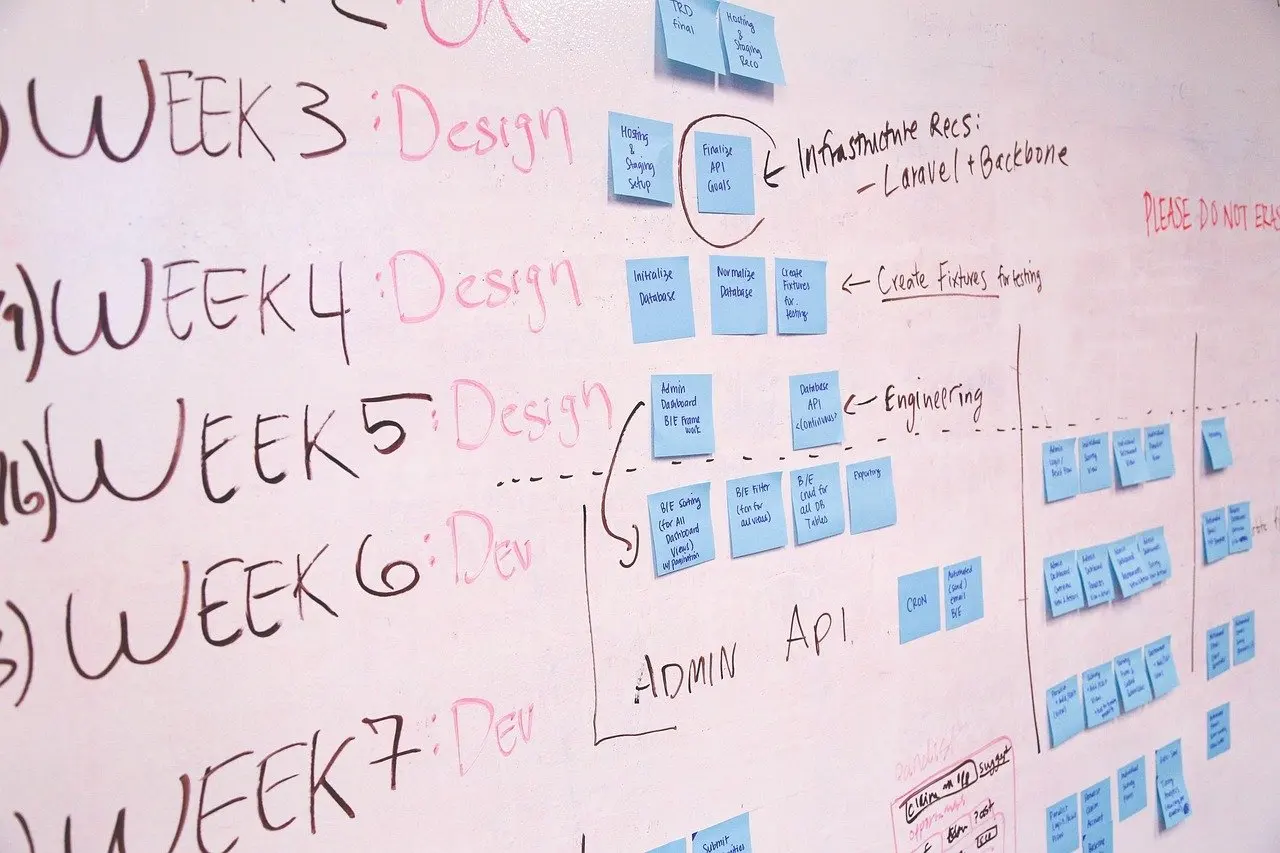
The description recognises both individual work and team coordination, particularly around databases. Teams often use a shared board to track who is doing what, and the picture below shows a board of that kind. A candidate who prefers solo work should look for roles that are clear about team expectations before applying.
Career path and comparing roles
National wage figures describe all employed workers and do not break pay out by seniority level. Anyone planning progression should therefore read an employer’s own published job levels and compare them with the wide pay band in the national data, rather than expect one national ladder.
Writing specifications and performance requirements is the duty in the national description that sits closest to design work. A path that moves toward design-heavy or planning-heavy work builds on that duty, while a path that stays close to building builds on the first two. Both draw on the same baseline skills, which is why this role works as a reference point for others.
Readers weighing engineering against roles that sit around it can compare the baseline here with what does a customer success manager do, or with what does a financial analyst do at a tech company, for contrasting day-to-day work in the same industry.
Frequently asked questions
Which places pay software engineers the most?
In May 2025, California had the highest state median wage for software developers at $174,410 per year. The highest-paying metro area was San Jose-Sunnyvale-Santa Clara, California, at $213,110. Mississippi’s median was $95,330, the lowest in the state table.
Is a degree always required?
A bachelor’s degree is the typical entry education. Among workers aged 25 and over, 51.7% held a bachelor’s degree as their highest education and 30.2% held a master’s degree in 2023-24. Only 2.2% had a high school diploma as their highest level.
Do many software engineers work for themselves?
Few do. About 1.5% of software developers were self-employed in 2025, so most work as employees.
What is the average hourly pay?
The mean wage in May 2025 was $71.20 per hour, which corresponds to the $148,100 mean annual figure. These are averages for all workers, not entry-level rates.